
Set up a learning session
Take a standard deck without jokers and choose a written rule set. Give each learner the same number of practice counters. Explain that counters cannot be bought, redeemed or transferred for anything of value. Keep the session about recognising hands and understanding turn order.
Decide whether A-2-3 or A-K-Q ranks first in your chosen format. Place that rule beside the ranking chart so nobody has to guess during an example.
Walk through one round
- Deal three cards to each learner. Keep hands separate so each person can inspect only their own cards.
- Name the category in your own hand. Ask whether it is a trail, pure sequence, sequence, colour, pair or high card.
- Describe the available choices aloud. Use the terms continue and pack before introducing more table vocabulary.
- When a comparison is allowed, reveal the hands. Compare category first and then apply the tie rules.
- Explain the result, collect the cards and reset. Repeat with open cards if a category is still confusing.
A beginner example
Suppose one learner has 8♣ 8♥ 3♦ and another has A♠ J♦ 9♣. The first learner has a pair and the second has a high-card hand. The pair is stronger, even though the other hand contains an ace. This illustrates why reading only the highest card leads to mistakes.
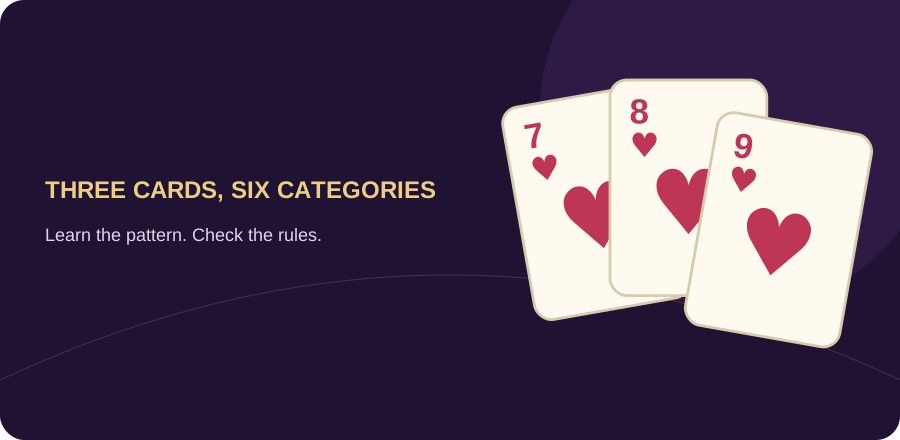
Next compare 5♥ 6♥ 7♥ with 9♣ 10♦ J♠. The first is a pure sequence, while the second is a mixed-suit sequence. Category comes before the highest rank again.
Before moving to an online format
- Read the specific game rules rather than relying on a general chart.
- Check whether the format uses virtual counters, financial stakes or redeemable items.
- Identify the operator, account recovery method and current legal availability.
- Choose a time limit and stop when it expires.
- Do not provide credentials to an information website or a person claiming to be a support agent.
Our online game guide explains the difference between a browser game, an Android app and this independent portal.
Common first-session mistakes
Treating every suited hand as a pure sequence is one mistake: the cards must also be consecutive. Treating every ace as a winning card is another: a stronger category can beat it. Finally, learning an unusual variation before the basic hierarchy makes rules harder to remember. Start with categories, then learn variation deliberately.