
Six categories, strongest first
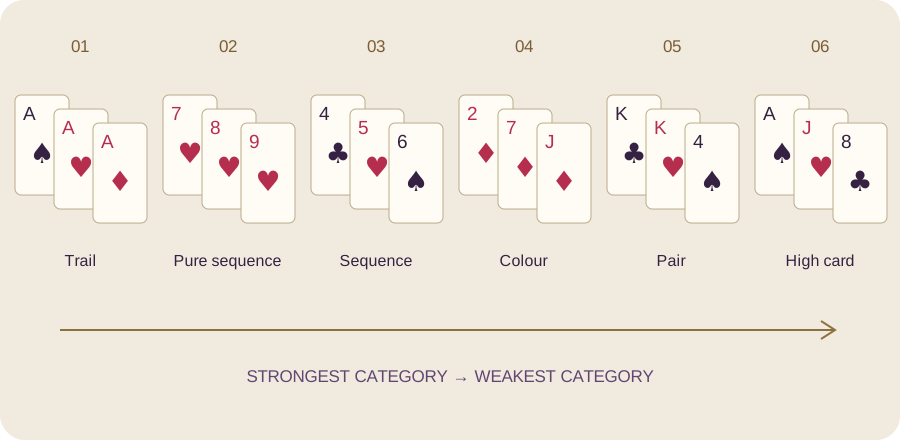
| Rank | Hand | Recognition | Example |
|---|---|---|---|
| 1 | Trail / trio | Three equal ranks | A♠ A♥ A♦ |
| 2 | Pure sequence | Consecutive ranks, one suit | 7♥ 8♥ 9♥ |
| 3 | Sequence / run | Consecutive ranks, mixed suits | 4♣ 5♥ 6♠ |
| 4 | Colour / flush | One suit, not a sequence | 2♦ 7♦ J♦ |
| 5 | Pair | Two equal ranks | K♣ K♥ 4♠ |
| 6 | High card | No category above applies | A♠ J♥ 8♣ |
Try a quick hand check
Which category is stronger?
A pair of kings or an ace-high hand with no pair?
Choose an answer to see the explanation.
A-2-3 or A-K-Q: check the rule set
There is no safe universal answer for every table or app. Some documented traditional rules place A-2-3 first; other formats put A-K-Q first. Read the table’s rule panel before deciding between these two runs. Both can be recognised as sequences, but their relative order is a separate rule.
K-A-2 is not a normal consecutive run under the classic conventions described here. A special variation can change the game, so do not assume the same chart applies when jokers or named variations are active.
How to resolve comparisons inside a category
| Category | Comparison to check |
|---|---|
| Trail | Compare the repeated rank |
| Pure sequence / sequence | Compare run order under the table’s ace convention |
| Colour / high card | Compare highest cards, then second, then third |
| Pair | Compare the pair first, then the unmatched card |
Two hands may remain equal after their ranks are compared. Do not invent a suit hierarchy to break the tie unless the actual rules specify one.
Three worked comparisons
- 2♠ 2♥ 9♦ versus A♣ J♥ 8♠: the first hand is a pair; the second is high card. The pair is in the higher category.
- 4♣ 5♥ 6♠ versus A♦ J♦ 8♦: a sequence is above a colour, even though the colour contains an ace.
- K♣ K♥ 4♠ versus Q♠ Q♦ A♥: compare the pairs first. Kings rank above queens; the ace kicker does not change that.
What this chart does not tell you
A hand chart identifies relative categories. It does not predict the next deal, prove the fairness of an app or guarantee any result. The interactive examples are fixed educational questions; they neither simulate gambling nor award prizes. Traditional rule reference ↗.